Showing posts with label Revolution. Show all posts

Saturday, April 08, 2017

OCTOBER REVOLUTION – Confirmation of Leninist theory of the Proletarian Revolution

Movement for the Reorganisation of the Communist Party of Greece 1918-55
OCTOBER REVOLUTION – Confirmation of Leninist theory of the Proletarian Revolution
The victorious outcome of the Proletarian Revolution in October (7 November) 1917 in Russia - with leading force the revolutionary proletariat in the alliance of workers-peasants and under the leadership of the revolutionary Bolshevik Party of LENIN-STALIN - marked the beginning of a new era in human history: it celebrated the passage from capitalism-imperialism to socialism and the beginning of the construction of the new socialist-communist society and confirmed:

First, the necessity and inevitability of the proletarian revolution and socialism-communism; that "the class struggle leads to the communist Revolution" (Marx) and that "the class struggle necessarily leads to the dictatorship of the proletariat, (that this dictatorship itself only constitutes the transition to the abolition of all classes and to a classless society ." (Marx, 1852) i.e. the communist society.

Second, the inevitable of the replacement of capitalism by socialism-communism: "Precisely as capitalism succeeded feudalism, socialism likewise will inevitably succeed capitalism". (Marx)

Third, it confirmed the correctness of the Marxist theory of revolution and in particular the Leninist-Stalinist theory of the Proletarian Revolution.

Marx's standpoint "from which the evolution of the economic formation of society is viewed as a process of natural history" (The Capital, Vol. 1, Preface to the First German Edition) studying and analyzing the pre-monopoly capitalism, more precisely "the capitalist mode of production, and the conditions of production and exchange corresponding to that mode" discovered the natural laws of its movement and "working with iron necessity towards inevitable results" - revealed "the dirty little secret of capitalist exploitation" and its fundamental contradictions, remarking at the same time 'the temporary nature of the capitalist system" and its investable succession of Socialism-Communism.
Later, LENIN, during the first 15 years of the 20th century, studied the new stage of capitalism, monopoly capitalism i.e. imperialism and discovered, amongst other things, the law of Uneven economic and political development of capitalism: " Uneven economic and political development is an absolute law of capitalism" (Lenin, On the Slogan for a United States of Europe, 1915). At the same time he expressed the Leninist theory of Proletarian Revolution, remarking that by this law: "the victory of socialism is possible first in several or even in one capitalist country alone" (Lenin, ibid.) and "The development of capitalism proceeds extremely unevenly in different countries. It cannot be otherwise under commodity production. From this it follows irrefutably that socialism cannot achieve victory simultaneously in all countries. It will achieve victory first in one or several countries, while the others will for some time remain bourgeois or pre-bourgeois" (Lenin, The Military Programme of the Proletarian Revolution, 1916)

The October Revolution took place in exactly in the base of this analysis and in that way it confirmed the Leninist theory of the Proletarian Revolution.

cFor organising and preparing the Proletarian Revolution - apart from the struggle of the working class to defend its class interests - for a revolutionary communist movement, the follow points are generally necessary (as opposed by all opportunistic currents):

1. The realisation that the proletariat is the revolutionary class of the capitalism society, its historical missions and leading role in the revolution (inside the alliance of working class - poor peasants): "the proletariat alone is a really revolutionary class" (Marx, Manifesto of the Communist Party). "It is to the great historic merit of Marx and Engels that they indicated to the workers of the world their role, their task, their mission, namely, to be the first to rise in the revolutionary struggle against capital and to rally around themselves in this struggle all working and exploited people" (Lenin, Unveiling Of A Memorial To Marx And Engels, 1918)

The proletariat, the gravedigger of capitalism, is not just a depressed and exploited class, but first of all the most revolutionary class of the capitalist society whose mission is the overthrow of the capitalism: "The chief thing in the doctrine of Marx is that it brings out the historic role of the proletariat as the builder of socialist society." (Lenin, The Historical Destiny of the Doctrine of Karl Marx, 1913). Since then the working class has inscribed "on their banner the revolutionary watchword: “Abolition of the wages system!"" (Marx, Value Price and Profit)

2. Recognizing the existence and necessity of a mass revolutionary Party of new type mouthpiece, organizer and leader of the proletarian struggle.

3. Recognizing the leading role of the Communist Party in the revolution as the organizer and leader.

But nevertheless the revolution in Russia in October 1917, would be impossible without a revolutionary situation in that historic period, as noted by Lenin for revolution in general: "a revolution is impossible without a revolutionary situation; furthermore, it is not every revolutionary situation that leads to revolution. What, generally speaking, are the symptoms of a revolutionary situation? We shall certainly not be mistaken if we indicate the following three major symptoms: (1) when it is impossible for the ruling classes to maintain their rule without any change; when there is a crisis, in one form or another, among the “upper classes”, a crisis in the policy of the ruling class, leading to a fissure through which the discontent and indignation of the oppressed classes burst forth. For a revolution to take place, it is usually insufficient for “the lower classes not to want” to live in the old   way; it is also necessary that “the upper classes should be unable” to live in the old way; (2) when the suffering and want of the oppressed classes have grown more acute than usual; (3) when, as a consequence of the above causes, there is a considerable increase in the activity of the masses, who uncomplainingly allow themselves to be robbed in “peace time”, but, in turbulent times, are drawn both by all the circumstances of the crisis and by the “upper classes” themselves into independent historical action.
Without these objective changes, which are independent of the will, not only of individual groups and parties but even of individual classes, a revolution, as a general rule, is impossible. The totality of all these objective changes is called a revolutionary situation". (Lenin, The Collapse of the Second International, 1915)
Leninism-Stalinism see the notions of "political crisis" and "revolutionary crisis" as identical: "On our speech we did not distinguish between political and revolutionary crisis. For us these concepts are identical" (Manuilsky: XI Plenary of the EC of the Communist International, March 1931)

The October Revolution confirmed the following Marxist positions in confrontation with the anti-Marxist treacherous reformists of the old Social Democracy and the new Khrushchevite social-democracy (20th Congress, in February 1956, "peaceful road" etc.) And other opportunistic currents:

a. Violent-Armed Revolution. The overthrow of the dictatorship of the bourgeoisie and the seizure of political power by the proletariat, when in a period of revolutionary situation a proletarian revolution erupts, it can only be achieved by revolutionary violence, an armed struggle which is the highest form of revolutionary class struggle: "the violent overthrow of the bourgeoisie lays the foundation for the sway of the proletariat" (Marx-Engels, Manifest of the Communist Party). The class struggle between the exploiters and the exploited - a key driver of the social development in all class societies - in the era of the proletarian revolution "has always, inevitably, and in every country, assumed the form of civil war" (Lenin, Letter To American Workers, 1918) and "To think that such a revolution can be carried out peacefully, within the framework of bourgeois democracy, which is adapted to the rule of the bourgeoisie, means that one has either gone out of one’s mind and lost normal human understanding, or has grossly and openly repudiated the proletarian revolution." (Stalin, Concerning Questions of Leninism, 1926)

Lenin was underlying that "The necessity of systematically imbuing the masses with this and precisely this view of violent revolution lies at the root of the entire theory of Marx and Engels" (Lenin, The State ad Revolution, 1917) and ironically characterized the opportunists of his times as "mummies, dried and shrunken in the atmosphere of lifeless scholasticism" (Lenin, Materialism and Empiro-criticism) who whine because "The school of civil war does not leave the people unaffected" (Lenin), "the very thought of peacefully subordinating the capitalists to the will of the majority of the exploited, of the peaceful, reformist transition to Socialism is not only extreme philistine stupidity, but also downright deception of the workers, the embellishment of capitalist wage slavery, concealment of the truth." (Lenin, Theses on Fundamental Tasks of The Second Congress Of The Communist International, 1920). .. "Only the forcible overthrow of the bourgeoisie, the confiscation of its property, the destruction of the entire bourgeois state apparatus from top to bottom—parliamentary. judicial, military, bureaucratic, administrative, municipal, etc.—right down to the wholesale deportation or internment of the most dangerous and stubborn exploiters and the institution of strict surveillance over them so as to foil their inevitable attempts to resist and to restore capitalist slavery—only such measures can ensure real submission of the whole class of exploiters." (Lenin, Ibid.)

b. Smashing the bourgeois state. After the victory of the revolution is absolutely necessary to smash down, break the bourgeois state machine (bourgeois army, police, security, courts, bureaucratic hierarchy, etc.) which is "essential for every real people's revolution" (Marx, Letter to Dr Kugelmann Concerning the Paris Commune, 12 April, 1871) which expresses "the principal lesson of Marxism regarding the tasks of the proletariat during a revolution in relation to the state." (Lenin, The State and Revolution, 1917). "The supersession of the bourgeois state by the proletarian state is impossible without a violent revolution." (Lenin, Ibid.) and moreover it is impossible by "improving the state machine" and it is achieved only by "smashing and destroying it" which is "the principal lesson of Marxism regarding the tasks of the proletariat during a revolution in relation to the state." (Lenin, Ibid.) "The law of violent proletarian revolution, the law of smashing of the bourgeois state machine as a preliminary condition for such a revolution, is an inevitable law of the revolutionary movement" (Stalin, The Foundations of Leninism)

The proletarian revolution and the conquest of power by the proletariat is impossible without both the armed struggle and "completely destroy the old state machine and replace it by a new one" and that " the liberation of the oppressed class is impossible not only without a violent revolution, but also without the destruction of the apparatus of state power" (Lenin, The State and Revolution, 1917)

These two Marxist positions were practical implemented in the course of the proletarian revolution of October in Russia, and later repeated in The Programme (1928) of the Communist International:

"The conquest of power by the proletariat does not mean peacefully “capturing” the ready-made bourgeois State machinery by means of a parliamentary majority. The bourgeoisie resorts to every means of violence and terror to safeguard and strengthen its predatory property and its political domination. Like the feudal nobility of the past, the bourgeoisie cannot abandon its historical position to the new class without a desperate and frantic struggle. Hence, the violence of the bourgeoisie can be suppressed only by the stern violence of the proletariat. The conquest of power by the proletariat is the violent overthrow of bourgeois power, the destruction of the capitalist State apparatus (bourgeois armies, police, bureaucratic hierarchy, the judiciary, parliaments, etc.), and the substitution in its place of new organs of proletarian power, to serve primarily as instruments for the suppression of the exploiters." (The Programme of the Communist International. Comintern Sixth Congress, 1928)

The working class can never use the bourgeois state.

The seizure of political power by the proletariat is impossible without the violent-armed revolution and without smashing the bourgeois state machine as claimed by the treacherous counterrevolutionary current international Khrushchevit revisionism (20th Congress of the CPSU, February 1956: aim "to capture a stable parliamentary majority "(!), pp. 41-42, Greek version) and the local representatives of social democratic leaders of "K"KE-SYRIZA who repeat the anti-Marxist positions of the old counter-revolutionary social democracy.

c. Establish Dictatorship of the Proletariat. The working class cannot defend and maintain its political power nor much more to build the socialist-communist society without the establishment of the Dictatorship of the Proletariat.

"The dictatorship of the proletariat cannot arise as the result of the peaceful development of bourgeois society and of bourgeois democracy; it can arise only as the result of the smashing of the bourgeois state machine, the bourgeois army, the bourgeois bureaucratic apparatus, the bourgeois police." (Stalin, The Foundations of Leninism)

From the law of the "uneven economic and political development of capitalism" (Lenin, On the Slogan for a United States of Europe, 1915) and the victory of socialism in "in several or even in one capitalist country alone" yields the Leninist-Stalinist conception of building socialism-communism in a single country: "the victorious proletariat of that country will arise against the rest of the world—the capitalist world—attracting to its cause the oppressed classes of other countries, stirring uprisings in those countries against the capitalists, and in case of need using even armed force against the exploiting classes and their states" (Lenin, Ibid.) which is obviously a position of Lenin himself and not just "of Stalin" as falsely claimed by the counter-revolutionary Trotskyites to attack only Stalin and not Lenin- Stalin (Stalin adopted and defended consistently this position).

Building the socialist-communist society is possible - as demonstrated by the practical construction of socialism-communism in Soviet Union of Lenin-Stalin up to 1953 - only by the existence and maintenance of the Dictatorship of Proletariat till Communism and the corresponding transition period which also extends to Communism: "Between capitalist and communist society lies the period of the revolutionary transformation of the one into the other. Corresponding to this is also a political transition period in which the state can be nothing but the revolutionary dictatorship of the proletariat." (Marx, Critique of the Gotha Programme, 1875) and not to Socialism as falsely claimed by the revisionists who distort Marx-Lenin (22nd Congress of the CPSU, 1961, p. 206, Greek version) and reject Marxism.

"The dictatorship of the proletariat can be exercised only through the Communist Party" (Lenin) and "the dictatorship of the proletariat is one party, the party of the proletariat, the Party of the Communists, which does not and cannot share leadership with other parties" (Stalin, Concerning Questions of Leninism)

The violent coup overthrow of the Dictatorship of the Proletariat in the early 1950s immediately after the death-murder of Joseph Stalin from the traitorous revisionist-social democratic group of Khrushchev-Mikoyan-Brezhnev et. al. interrupted the building of Socialism-Communism in the Soviet Union, yet was the beginning of the gradual restoration of capitalism, which was completed in the mid-1960s.
Read More »

Tuesday, January 15, 2008

V.I. Lenin: Our Revolution (Apropos of N. Sukhanov's Notes)

The text translated in Greek published in Anasintaxi issue 265 (1-15/1/2008)
I

I have lately been glancing through Sukhanov's notes on the revolution. What strikes one most is the pedantry of all our petty-bourgeois Democrats and of all heroes of the Second International. Apart from the fact that they are all extremely fainthearted, that when it comes to the minutest deviation from the German model [of Socialism] even the best of them fortified themselves with reservations — apart from this characteristic, which is common to all petty-bourgeois Democrats and has been abundantly manifested by them throughout the revolution, what strikes one is their slavish imitation of the past.

They all call themselves Marxists, but their conception of Marxism is impossibly pedantic. They have completely failed to understand what is decisive in Marxism, namely, its revolutionary dialectics. They have even absolutely failed to understand Marx's plain statements that in times of revolution the utmost flexibility is demanded, and have even failed to notice, for instance, the statements Marx made in his letters — I think it was in 1856 — expressing the hope of combining the peasant war in Germany, which might create a revolutionary situation, with the working-class movement — they avoid even this plain statement and walk around and about it like a cat around a bowl of hot porridge.

Their conduct betrays them as cowardly reformists who are afraid to deviate from the bourgeoisie, let alone break with it, at the same time they disguised their cowardice with the wildest rhetoric and braggartry. But what strikes one in all of them even from the purely theoretical point of view is their utter inability to grasp the following Marxist considerations: up to now they have seen capitalism and bourgeois democracy in Western Europe follow a definite path of development, and cannot conceive that this path can be taken as a model only mutatis mutandis, only with certain amendments (quite insignificant from the standpoint of the general development of world history).

First — the revolution connected with the first imperialist world war. Such revolution was bound to reveal new features, or variations, resulting from the war itself, the world has never seen such a war in such a situation. We find that since the war the bourgeoisie of the wealthiest countries have to this day been unable to restore "normal" bourgeois relations. Yet our reformists — petty-bourgeois who make a show of being revolutionaries — believed, and still believe, that normal bourgeois relations are the limit (thus far shalt thou go and no farther). And even their conception of "normal" is extremely stereotyped and narrow.

Secondly, they are complete strangers to the idea that while the development of world history as a whole follows general laws it is by no means precluded, but, on the contrary, presumed, that certain periods of development may display peculiarities in either the form or the sequence of this development. For instance, it has not even occurred to them that because Russia stands on the borderline between civilized countries and the countries which this war has for the first time definitely brought into the orbit of civilization — all the Oriental, non-European countries — she could and was, indeed, bound to reveal certain distinguishing features; although these, of course, are in keeping with the general line of world development, they distinguish her revolution from those which took place in the West European countries and introduce certain partial innovations as the revolution moves on to the countries of the East.

Infinitely stereotyped, for instance, is the argument they learned by rote during the development of West-European Social-Democracy, namely, that we are not yet ripe for socialism, but as certain "learned" gentleman among them put it, the objective economic premises for socialism do not exist in our country. Does it not occur to any of them to ask: what about the people that found itself in a revolutionary situation such as that created during the first imperialist war? Might it not, influenced by the hopelessness of its situation, fling itself into a struggle that would offer it at least some chance of securing conditions for the further development of civilization that were somewhat unusual?

"The development of the productive forces of Russia has not yet attained the level that makes socialism possible." All the heroes of the Second International, including, of course, Sukhanov, beat the drums about this proposition. They keep harping on this incontrovertible proposition in a thousand different keys, and think that it is decisive criterion of our revolution.

But what if the situation, which drew Russia into the imperialist world war that involved every more or less influential West European country and made her a witness of the eve of the revolutions maturing or partly already begun in the East, gave rise to circumstances that put Russia and her development in a position which enabled us to achieve precisely that combination of a "peasant war" with the working-class movement suggested in 1856 by no less a Marxist than Marx himself as a possible prospect for Prussia?

What if the complete hopelessness of the situation, by stimulating the efforts of the workers and peasants tenfold, offered us the opportunity to create the fundamental requisites of civilization in a different way from that of the West European countries? Has that altered the general line of development of world history? Has that altered the basic relations between the basic classes of all the countries that are being, or have been, drawn into the general course of world history?

If a definite level of culture is required for the building of socialism (although nobody can say just what that definite "level of culture" is, for it differs in every Western European country), why cannot we began by first achieving the prerequisites for that definite level of culture in a revolutionary way, and then, with the aid of the workers' and peasants' government and Soviet system, proceed to overtake the other nations?

January 16, 1923

II

You say that civilization is necessary for the building of socialism. Very good. But why could we not first create such prerequisites of civilization in our country by the expulsion of the landowners and the Russian capitalists, and then start moving toward socialism? Where, in what books, have you read that such variations of the customary historical sequence of events are impermissible or impossible?

Napoleon, I think, wrote: "On s'engage et puis ... on voit." rendered freely this means: "First engage in a serious battle and then see what happens." Well, we did first engage in a serious battle in October 1917, and then saw such details of development (from the standpoint of world history they were certainly details) as the Brest peace, the New Economic Policy, and so forth. And now there can be no doubt that in the main we have been victorious.

Our Sukhanovs, not to mention Social-Democrats still farther to the right, never even dream that revolutions cannot be made any other way. Our European philistines never even dream that the subsequent revolutions in Oriental countries, which possess much vaster populations in a much vaster diversity of social conditions, will undoubtedly display even greater distinctions than the Russian Revolution.

It need hardly be said that a textbook written on Kautskian lines was a very useful thing in its day. But it is time, given that, to abandon the idea that it foresaw all the forms of development of subsequent world history. It would be timely to say that those who think so are simply fools.

January 17, 1923

Read More »

Thursday, November 08, 2007

Muscovites rally for October Revolution anniversary


About 50,000 Muscovites, mostly young people and pensioners, gathered Sunday in the center of the capital city to mark the 87th anniversary of the October Revolution in 1917 leading to the founding of the former Soviet Union. (Itar-Tass Photo)
Read More »

Sunday, November 04, 2007

90th Anniversary of the Great October Revolution

> Download the text in 8 languages (FR, ES, EN, PT, IT, EL, RU, DE) here

Declaration of the International Conference of Marxist Leninist Parties and Organisations

"We want to transform the world. We want to put an end to world imperialist world war, in which hundreds of millions of people are involved [...] and it will not be possible to an end to this war though a true democratic peace without the most significant of all the revolutions of mankind, namely the proletarian revolution." (V. I. Lenin, April 1917).

The Great Revolution of October has risen up the enthusiasm and the hope of the proletarians and the people all over the world and at the same time, it has provoked the tremendous hate of the capitalist classes, of the reaction, against the Bolshevik Party and its leaders. It was a revolution never seen before in mankind’s' history, a revolution "which has deeply shaken the world".
In Russia, the revolution gave birth not only to a State and to a government of new type: it created a true civilization, a superior way of life (the socialisation and collectivisation), an organisation based in equality and freedom for the people and which provoked a swarming of cultural and scientific life which astonished the whole world.

The USSR has been, for tens of years, a decisive factor in human history: it managed to consolidate an iron unity among the people which has permitted to overcome with success the severe trails it has been confronted, namely, the civil war, the imperialist intervention, the collectivisation and industrialisation, the war of extermination and the invasion of the Nazis, stimulated by the western so called democratic states, the astonishing reconstruction after the war, etc.

Among the multiple lessons and experiences that we can draw from the Revolution of October, from the action of the first socialist State in history, we want to underline the practise of proletarian international solidarity, synthesized in the famous and accurate slogan of the Communist Manifesto "proletarians of all countries, unite!»

It's an active proletarian solidarity, which does not limit itself to words, as do the social democrats and others. The soviet power has put it in practice, in a clear and radical way, transforming the empire of tzar in a Union of Republics, based on the voluntary adhesion of the people and their numerous nationalities.
In return, the USSR could rely on the international solidarity in its struggle against the imperialist coalition, allied with Kerensky, who in the first months of the revolution, hoped to asphyxiate it and who launched a cruel civil ar. The sailors of the Black Sea, under the leadership of the Communist Marty, have refused to attack the USSR: they are an example of solidarity, which, linked to the adjective proletarian must be the norm in the relationships between brother parties, based on equality, taking in account their unequal political and organisational development.


International solidarity does not express itself only in specific manifestatio
ns, more or less of great significance, as, for example, the International Brigades which fought against Nazi-fascism in Spain: it also takes organisational forms. It’s the way Marx, Engels, Lenin and Stalin and all the great revolutionaries have conceived it. From the Great October Revolution, Lenin and the Bolsheviks have organized the IIIth International which has fixed as task, among others, the founding of Bolshevik parties; we call them today Marxist Leninist, in all the countries. It’s a task for today too. The International Conference of Marxist Leninist Parties and Organisations (ICMLPO) is an expression of this necessity, without been yet a new International. Proletarian solidarity which has been vigorously defended by Lenin, Stalin, Dimitrov, etc. is the international solidarity between the proletarians of the whole world: as the Bolsheviks did, it must be one of the principles and one of the components of the true Marxist Leninist parties.

In the same way, following the example of the great leaders of the construction of socialism in USSR, we affirm that the revolutionary violence is indispensable to overthrow bourgeoisie and the other capitalist forces which are acting against the proletariat and the people of the world. The revolutionary violence, at a certain stage of the class struggle, is completely part of it. Revolutionary violence, whose highest expression is proletarian dictatorship, "the organisation of the vanguard of the oppressed in dominating class, in order to suppress the oppressors" is one of the most attacked principles, slandered by social-democrats, revisionists and opportunists of all hues. Khrushchev, in the infamous XXth congress, has launched a series of attacks and slanders against Stalin, against the revolutionary violence and the proletarian dictatorship. Stalin, the great follower of Lenin, developed an implacable struggle in order to apply this principle, a struggle which remains engraved in the spirit of all the Communists. We defend the work of Stalin and say, as Lenin said:

"Only can be considered as Marxist, those who go to the end in the recognition of class struggle, who recognize the necessity of proletarian dictatorship. In this relays the most fundamental difference between a Marxist and a petit (or great) vulgar bourgeois."

It’s amid the great achievements of the soviet power, amid the difficulties and the problems that the betrayal of Khrushchev and his followers, has emerged. It undermined the roots of the socialist State and provoked the enthusiasm of the bourgeoisie and the reaction all over the world. It must be stressed that the modern revisionists, under different forms and covers, belong to the same opportunist and anti Marxist Leninist bloc. The reaction has announced the end of the communist ideas, the end of the decisive role of the proletariat and the working class, and, finally, the uselessness of the communist parties.

We, as parties and organisations belonging to the ICMLPO, we affirm strongly that the communist party is the indispensable motor which brings the consciousness, which organises and leads the proletariat, the main force in its revolutionary struggle, in alliance with the poor peasantry, where it still exists, and with the popular strata. The development of imperialism, the great steps made by technology, the discoveries of all types, have not liquidated the class struggle and they cannot do it. All the successes of the epic of October, under the leadership of Lenin and Stalin, remain completely actual: class struggle remains the motor of History and the communist party gives the main impulse that, as Marx said:
"Men can liberate themselves only through their own action and not because of the caprice of a Maecenas or because of the mere will of a brigt dictator"

The thesis on the weak link, in other words, the point where the fundamental contradictions are at the highest stage, especially the contradiction between proletariat and bourgeoisie, remains totally actual. We must take it in account, for the tactical international struggle of the communists. Nevertheless, the imperialist chain will break in one or several weak links, and will end with the destruction of capitalism and the instauration of socialism, only if the struggle is directed by a true communist party, as the October revolution has proved it in 1917. Indeed, Russia was a weak link of the capitalist system but it was not the only one. It’s only the communist party, with its firm leadership, that gained the leadership of the toiling masses, the peasants and the soldiers, who made this link burst apart, have assaulted the Winter Palace and who have taken the power for the Soviets. Its one of the greatest lesson and experience of this heroic epoch which will remain engraved in the annals of the revolution and which are still guiding and stimulating us.

We can say, without any doubt, that without a Marxist Leninist party, forged in the struggles and with a strong ideology, capable of firmness and audacity in the questions of organisation, with experienced leaders, able to foresee and accelerate the events in certain circumstances, without such a party, the masses can win temporal successes, partial victories, but they will never achieve the revolution, because "only a party guided by a vanguard theory can accomplish the mission of a vanguard combatant".

In commemorating the 90th anniversary of the Great October Revolution, leaded by Lenin, Stalin and other great Bolshevik leaders, the International Conference of Marxist Leninist Parties and Organisations wants to stress on the actuality and the validity of Marxism Leninism, for the working class and the people of the world, in front of the pseudo Marxist theories, as anarchism, social-democratism, eurocommunism, Trotskyism, and all kind of utopias, that try to penetrate the working class and the progressive sectors. Several theories put forward by the bourgeoisie and its army of "critical" intellectuals are no more than old recycled theories, under new covers, which always end in helping the reaction. Here you have the new philosophers which discover nothing new, theorists that are theorizing, minimizing and ignoring his strength of action, of the practice. Their analyses do not aim at drawing conclusions; they are theories that explain pre established conclusions. They claim that Marxism is outdated, that Leninism is opposing Marxism, etc. They produce theories that "go ahead from Marxism". For us, Marxism, enriched by the immense contribution, full of genius, of Lenin (the Marxism Leninism) is not only accurate, but we are convinced that the development of proletarian and revolutionary forces, are depending from its right application, that Marxism will root itself deeply in the masses, that the impulse for the vital struggle for tumbling and eradicate capitalism, for engaging the process of construction of socialism, are depending on the correct application of Marxism. We remind the famous words:

"Marxism Leninism is the science related to the laws of nature and of society, to the revolution of the oppressed masses (...) it’s the ideology of the working class and of its communist party".

It’s a vivid science, in motion: it is not and will never be a prayer book, a dogma, for the communists, but a guide for action and for dialectical analysis. As Lenin underlined "without a revolutionary theory, there cannot be any revolutionary movement".

We also remind these other words of Lenin:

"The Russian proletariat had the honor to begin, but we must not forget that its movement and its revolution are only a part of the revolutionary worldwide proletarian movement".

Hail the Great October Revolution!
Hail Marxism Leninism!
Hail International solidarity!


International Conference of Marxist-Leninist Parties and Organizations (ICMLPO)
October 2007
Read More »

Tuesday, October 09, 2007

The victory of the Great October Revolution and the successful construction of socialism

Article scheduled to be published in "Unity & Struggle" issue 15

The victory of the Great October Revolution and the successful construction of socialism
The greatest historical validation and confirmation of Marx’s scientific theory.

November of this year will mark the 90th anniversary of the Great October Socialist Revolution, the greatest event of the 20th century that resulted, for the first time, in the rise of the workers, peasants and soldiers and the establishment of the first proletarian state in human history. All generations in the 20th century solemnly honour the Great October Socialist Revolution.

The victorious outcome of the Proletarian Revolution in Russia marked the beginning of a new era in human history and constituted the greatest historical validation and confirmation of Marx’s scientific theory regarding three fundamental questions.

First, regarding the historical necessity and inevitability of the proletarian revolution and socialism; that “the class struggle leads to the communist Revolution (Marx). The historical necessity and inevitability of the proletarian revolution are rooted in the laws underlying the development of the material forces of production and their conflict with the obsolete relations of production of the last antagonistic socio-economic formation, capitalism. As Marx wrote: “Precisely as capitalism succeeded feudalism, socialism likewise will inevitably succeed capitalism”.


Second, regarding the possibility of the practical application of socialism, considered by the bourgeois theorists a utopia and impossible. Until the victory of the October Socialist Revolution, socialism was a scientific theory that hadn’t been applied yet. Through the construction of socialism in the Soviet Union of Lenin-Stalin, it was proved for the first time that socialism does not constitute merely a scientific theory but a social system that can be established and demonstrate its superiority over capitalism.

In this way, all claims made by the bourgeois theorists and economists that the socialist economy is allegedly an “irrational” one (due to the absence of private property, market and competition) and, therefore, unable to prevail and operate, are refuted. (N.G. Pierson, L.v. Mises, M. Weber, A. Weber, and others).

Third, regarding the fact that the construction of socialism-communism is possible only on the condition that the principles of revolutionary Marxism are steadfastly upheld and followed. The incorrect conduct of the class struggle against the counter-revolutionary and anti-socialist forces after Stalin’s murder resulted in the prevalence of the Khruschevian revisionist counter-revolution.

The victory of the October Socialist Revolution also confirmed all the tenants of the Leninist-Stalinist theory of Proletarian Revolution

Firstly, it confirmed that the revolutionary proletariat, being in close alliance with the poor peasantry, is the main, decisive and leading force of the Proletarian Revolution.

Secondly, it confirmed the necessity for a revolutionary party which is equipped with the theory of Marx-Engels-Lenin-Stalin in the role of organiser and leader of the revolution which doesn’t share its leadership with other parties.

Thirdly, it confirmed that the path of armed insurrection is the only path to the overthrow of capitalism.

Fourthly, it confirmed the necessity for the smashing of the bourgeois state machinery as an essential condition for the establishment of the dictatorship of the proletariat, “that will be led by a single party, the party of communists, which will not and should not share its leadership with other parties” (Stalin).

Fifthly, it confirmed that the dictatorship of the proletariat is necessary for the whole transitional period from capitalism to communism.
The legendary events that took place in Russia during the “10 days that shook the world”, in October of 1917, did not come out of the blue. After three years of engagement in the imperialist First World War, the situation in the Eastern Front was desperate. The ill-led, wretchedly equipped Russian Army had been cut to pieces by the Germans. Shaken by the impact of the war and rotted from within the feudal Tsarist regime tottered and fell. In March, thousands of exasperated soldiers poured from the front to the cities and together with workers forced Tsar Nicholas II to abdicate. A Provisional Government was established with Prime Minister Alexander Kerensky. But even after the collapse of the autocracy, the Revolution was only beginning.

The Provisional Government didn’t heed the cry for Peace, Bread and Land! that swept across the vast country summing up the immediate longings and the ancient aspirations of the war-weary, starved and dispossessed Russian millions. This brought the Mensheviks and the Socialist Revolutionaries in difficult position because while, Kerensky’s partners in the Provisional Government, they were at the same time the dominating forces in the Soviets; the elected bodies of the revolutionary workers, peasants and soldiers. On the other hand, the influence of the Bolsheviks in the Soviets and among the workers in general was constantly rising. Contrary to the bourgeois and socialist parties, the Bolsheviks were adhered to the unfulfilled aims of the February revolution. Moreover, at a time when the reactionary forces and the Provisional Government kept postponing the convention of the Constituent Assembly, the Bolsheviks went a step further demanding the transfer of all state power to the Soviets.

In September 1917 matters reached a crisis. Against the overwhelming sentiment of the country, Kerensky formed a Coalition Government with the propertied classes. As a result the Mensheviks and the Socialist Revolutionaries lost the confidence of the people forever. Around the same time the Tsarist General Kornilov, organised a revolt with the object of crushing the revolution and of restoring czarism. The Central Committee of the Bolshevik Party called upon the workers, soldiers and sailors to rise in defence of the revolution. All this speeded up the Revolution even more and put the armed insurrection on the order of the day. On Lenin’s proposal a Party Centre headed by Stalin was set up to direct the insurrection.

By the morning of 7th of November (25 October, Old Style), the telephone exchange, the chief telegraph office, the radio station, the bridges across the Neva, the railway stations and the most important government offices were in the hands of the insurgent proletariat. The Winter Palace, the seat of the Provisional Government, had also been captured. The signal for the storming of the Palace by detachments of Red Guards and sailors was a blank shot from the guns of the cruiser “Aurora”. The insurrection had succeeded. At 10 a.m. the Military Revolutionary Committee issued its historic manifesto drawn up by Lenin, addressed “To the Citizens of all Russia” proclaiming to the masses of the people the overthrow of the Provisional Government and the transfer of the state power to the Soviets. In the evening, the Second Congress of Soviets was opened in Smolny. The transfer of all power, central and local, to the Soviets was officially proclaimed.

Thanks to the heroism, faith and self-denial of the advanced working masses and the ardent guidance of the Bolsheviks, the flame of the October Revolution spread in almost a month to all cities and regions of Central Russia. In Moscow, Novgorod, Ekaterinenburg the bourgeois-capitalist rule was overthrown and the new proletarian rule was founded.

The great thinker Lenin, by creatively applying and further developing the Marxist theory in accordance to the conditions of his time, showed the way to the October Revolution that eliminated the vestiges of serfdom, liberated the people of tens of nationalities from the bondage of the bestial tsarist regime, socialised all the means of production and the natural resources of the country and established the workers-peasants power. The October Revolution, by far the most significant event of the 20th century, literally changed the course of human history. For the first time since the dawn of civilisation, the ancient dream of the exploited toiling masses came true; the exploitation of man by man was abolished. What’s more, the oppressed masses became masters of their own land, of their own destiny.

The October Revolution awakened millions of working masses all around the world and shook the foundations of the barbaric and brutal imperialism. It helped the people of the capitalist countries, primarily Britain, France and Germany, become even more aware of the utter futility of the imperialist war that served only the interests of the European ruling circles. In one country after another, communist parties were founded adhering to the Bolshevik revolutionary principles and tactics. The class struggle between the bourgeoisie and the proletariat become bitter. In some cases, socialist revolutions broke out like in Germany and Hungary where resulted in short lived Soviet Republics. The people in countries under colonial rule, China, India, Persia and elsewhere also rose against their rulers. The world colonial system entered a period of prolonged and deep crisis that would eventually bring its end after the Second World War.

The October Revolution proclaimed the advent of a new era in the history of all mankind, the era of proletarian revolution and proletarian dictatorship, the era of transition from capitalism to communism. The Russian workers by making their “leap to heavens” paved the way for their brothers in other countries to follow suit. As Lenin wrote: “We started this work. How long it will take and whose country’s proletarians are going to finish is not the main issue. The main issue is that the ice is broken, the road is open, and the course is set”. The October Revolution gave birth to the International Communist Movement and favoured its gradual development. It led to the establishment of the Third International (1919-1943) which replaced the bankrupt and treacherous Second International. Henceforth, the Third International became a force that imperialism had to reckon with in all its future plans. It was the headquarters of the International Proletarian Revolution. Being members of the Third International, the Communist Parties were able to draw from the long revolutionary experience of the Bolsheviks and play a leading role in the struggle of the workers in their own countries.
Leaders like Lenin and Stalin who perform such feats are born perhaps once in a millennium. “Leaders” are not the ones named by all kinds of adventurists, exploiters and mobsters. Leaders are those who have unshakable devotion to ideals that fully express the true interests and the wishes of the masses, wretched by the exploitation and oppression of the world tyrants. Together Lenin and Stalin annihilated the remnants of the tsarist armies and the hordes of intervention sent to the land of Soviets by the imperialist and other European countries, including Greece, in order to overthrow the proletarian power. After Lenin’s death, Stalin solemnly swore before the great leader’s coffin to continue his work. He kept this oath up to the last letter.

As the leader of CPSU and the people of the Soviet Union, Stalin successfully carried out the Leninist policy of industrialisation, and collectivisation of the country through the launch of the five-year plans and surpassing enormous difficulties and problems. But nothing would be possible without the monolithic unity of the Bolshevik Party. And this Stalin maintained, like “the apple of his eye”, by crushing ideologically and politically all the opportunistic factions that opposed the socialist construction; the groups of Trotsky, Zinoviev, Kamenev and Bukharin. All those who turned out to be nothing more than common criminals, saboteurs and murderers, paid agents of fascism and imperialism. Stalin led the party and the people of the Soviet Union in all fields scoring huge successes in economy, defence, education, health, culture, sciences, research, technology and generally, in social and cultural development. In a slightly more than a decade, the country was transformed into an industrial and military superpower. Stalin, CPSU and the Soviet Union became a legend and humanity’s star of hope and pride.

The industrial and military might acquired with the first second and third five plan allowed the Soviet people to achieve the greatest triumph of all centuries: the victory over the German Nazism, the Italian and Japanese fascism in the Great Patriotic War. Compared to its allies, the Soviet Union bore the greatest weight of the war and paid an extremely high price for it. This, historically well-established, fact is evident not only from the sheer size of the human losses – more than 20 million dead – but also from the devastation of the Soviet homeland which was of shocking scale.
Soon after the Great Victory, the heroic and proud people of the Soviet Union accomplished new feats of labour by almost completing the reconstruction of their vast country from 1945 to 1952. Alas, the internal class enemies, though defeated, had not been totally eliminated. As a matter of fact, throughout the whole period of the Great Patriotic War and the reconstruction of the devastated homeland, the dark reaction, the crypto-fascists and the revisionists in the ranks of the mass organisations, and especially CPSU, were undermining the work of CPSU and the Soviet state using all possible means, not excluding terrorist methods. They murdered Zhdanov, Schernbakov in 1948 and in 1953 I. V. Stalin himself. For this purpose, they employed a group of doctors that had been recruited in a US-based secret organisation whose mission was to eliminate the People’s Republics leaders, eminent scientists and state officials from all progressive countries. The victims of the doctor’s gang, that numbered about 70 members in the Soviet Union, were many. Although they were all arrested, they were acquitted and released later by Khrushchev apart from nine of them who had been already executed for the murder of Zhdanov and Stalin.

The murder of Stalin was followed by the murder of a whole series of party and state officials such as the Moscow and Kremlin Garrison Commanders, 29 top ranking cadres of State Security, many cadres from the Soviet Republics, and the leaders of almost all the People’s Republics; Wilhelm Pieck from Germany, Klement Gotvald from Czechoslovakia, Boleslaw Beirut from Poland, Ana Pauker from Romania, Vulko Chervenkov from Bulgaria, Matias Rakosi from Hungary and Nikos Zachariades from the Communist Party of Greece (KKE).

Behind all these crimes they were the counter-revolutionary group of N. Khrushchev, A. Mikoyan, L. Beria, Mikhail Suslov and others plotting against the Soviet power, socialism and aiming at the restoration of capitalism. But coming out openly with these goals, as early as 1953, would only amount to their suicide. They were compelled to proceed gradually, being cautious in every step. Most importantly, they had to find another target that would serve their sinister purpose indirectly. Of course that target was Stalin and his world-historical work. By condemning (that is slandering) Stalin and his alleged excesses and mistakes, the crypto-fascists revisionists condemned the man who incarnated the very triumph of socialism not only in USSR but in one-third of the world.

The next step was the official revision of Marxism-Leninism that started with the 20th Congress (“peaceful transition” etc.) and continued with the decisions of the 22nd Congress of CPSU (“state of all people” etc). Once revisionism seized political power, it moved on with its economical programme; a series of individual reforms carried out immediately after the 20th Congress (simultaneously with the overthrow of the dictatorship of the proletariat) that culminated in the so-called Kosygin reforms in 1964-65 resulting in the gradual but complete restoration of capitalism in the Soviet Union and transforming it from the centre of world revolution into the centre of revisionist counter-revolution.

Some of Khrushchev’s other despicable political actions include the following: 1) The purge of almost all CPSU cadres (c.a. 98%) 2) The discharge and replacement of elite officers of all ranks and fighting services 3) The replacement of the administrative machinery (c.a. 94%) in all branches of production, in educational and research institutes, in hospitals and cliniques 4) The liquidation of the World Peace Movement 5) The violent intervention and liquidation of the communist movement throughout the world 6) The establishment of a system of corruption, bribery, and embezzlement. 7) The encouragement of unlimited consumption of alcohol and the emergence of an increasing criminality in all socialist countries. 8) The formation of a capitalist caste of privileged officials – the “nomenclature” – in all fields. 9) The introduction of cosmopolitanism and the exhibition of the capitalist way of life and culture in socialist societies. 10) The blemish, the vulgar slandering of the work and history of CPSU, its leadership and the Soviet people. 11) The extortion of recantations (about 1000 a day published in Pravda) from party, science economy cadres. All this turned the country into a vast breeding-ground for the final figures of the treason, such that has never been witnessed by humanity throughout the centuries: M. Gorbachev, B.Yeltsin, A. Yakovlev, E. Sevardnadze and Co.

The prevalence of the Khruschevites in CPSU resulted in a new status quo in the communist movement and in the socialist camp. They tried to impose the new counter-revolutionary line adopted in the infamous 20th Congress to all communist parties in the world. In order to achieve this, they employed every possible means of intervention in the internal affairs of the fraternal parties, every kind of pressure and threat, political and economical blackmail. All the communist parties that adopted the ideological-political line of the 20th Congress degenerated into bourgeois, socialdemocratic parties. The case of our party, KKE, is worth mentioning briefly because it was the first party in the world that experienced a violent revisionist attack. The peculiar circumstances under which our party was working during that period were favourable to this intervention. In 1949, after the end of a heroic three-year armed struggle against the Greek royal-fascism and Anglo-American imperialism, the majority of the KKE members and cadres were forced to leave their country and settle in the Soviet Union and the other socialist countries.

Even before the 20th Congress, when the Khrushchevites realised that the KKE leadership headed by Nikos Zachariades is not going heed their calls to abandon the revolutionary Marxist-Leninist-Stalinist course and follow the anti-Stalinist revisionist course, they made a further step. They proceeded to form a right opportunist faction in the Tashkent Party Organisation (KOT), and to promote this faction right up to the Organisation’s leadership. KOT was the largest KKE Party Organisation in the socialist countries and the Khrushchevites knew that if they managed to subjugate it then it would be much easier to subjugate the whole Party. However, the revolutionary KKE leadership headed by Nikos Zachariades immediately took measures and removed fraction’s cadres from the leadership of KOT. This was just the pretext for the pre-planned open provocation that followed. On the 9th of September 1955, around 400 factionists, armed with knives and sticks, attempted to capture by force the offices of KOT, serving at that time as a temporary seat of some visiting members of the CC of KKE. This bloody pogrom failed thanks to the overwhelming resistance of the Greek communists in Tashkent many of whom suffered knife injuries in the clash with the factionists. The whole operation was under the guidance of Saakov, KGB Colonel Saakov who, in turn, was employed by Boris Panomariov, the member of the CC of CPSU entrusted with the KKE affairs.

The overwhelming majority of the Greek communists in Tashkent and other Party organisations wholeheartedly condemned this despicable act of violence and provocation and supported the lawful leadership of KKE headed by Nikos Zachariades. The Party’s unity was evidently expressed in the elections of representatives for the KOT Conference which would appoint a new KOT Bureau; the majority of the elected representatives were loyal to the lawful KKE leadership. It was evident that the KOT Conference would amount to the political death of the faction but following an order from CC of CPSU the Conference was cancelled.

In the 20th Congress of CPSU, the Khruschevites formed the so-called “International Committee of Fraternal Parties” consisting of cadres from the Soviet, Romanian, Hungarian, Polish, Czechoslovak and Bulgarian parties. However, their behaviour towards KKE was anything but fraternal. The International Committee openly and without pretexts intervened in KKE by arbitrarily summoning the infamous 6th Plenum (March 1956). This illicit body was convened by summoning a whole bunch of former, i.e. removed, KKE cadres but not the General Secretary of the Party Nikos Zachariades. The report was read by the Romanian opportunist Georgiu Dez. The 6th Plenum illegally and forcibly removed the lawfully elected revolutionary leadership of KKE, including the Party’s General Secretary Nikos Zachariades, who was arrested and isolated, and appointed a right opportunistic puppet leadership that consisted of individuals like K. Koligianis, K. Tsolakis (who participated in the bloody pogrom in Tashkent aiming at the murder of Zachariades), M. Partsalidis and others. The 6th Plenum adopted the counter-revolutionary social-democratic line promulgated in the 20th Congress of CPSU. What followed was the expulsion from the party of thousands of communists who were staunch Marixst-Leninists and loyal to the lawful KKE leadership.

The years that followed 1956 were years of fascist persecutions of all the Greek communists, who remained faithful to Stalin and Zachariades by the Soviet and Greek Khrushchevian revisionists. These persecutions took various forms: surveillance, spying, arrests, imprisonments, exile to Siberia, etc. Thousands party cadres were exiled to Siberia and among them the Party’s General Secretary, Nikos Zachariades, who, after 17 years of exile, was murdered in Sorgut by the treacherous Brezhnev-Florakis clique so that he wouldn’t return alive to Greece and upset their plans.

Essentially a new party emerged out of 6th Plenum. This new party shamelessly usurped the name “K”KE although it has been, from the very beginning, a bourgeois social democratic party which bears no political, ideological or organizational relation with the revolutionary KKE. The anti-Stalinism of this 6th Plenum abortion is evident even today not only from its everyday political tactics but also from its hypocritical statement for the 90th anniversary of the October Revolution.

We mention only a few: a) No reference is made to the vital and irreplaceable role of Stalin in the October Revolution, in the Civil War and, above all, in the construction of socialism during the whole period 1924-1953. b) The line promulgated by the 7th Congress of the Third International in 1935 that set as primary task for the Communist parties the anti-fascist struggle is considered mistaken. c) The absolutely right decision on the self-dissolution of the Third International in 1943 is said to have deprived the Communist Movement of the decision centre needed to devise a strategy against imperialism. At the same time, it is held that Comniform didn’t manage to fulfil this role after the war. d) The Stalinist leadership of CPSU is actually blamed for underestimating the intra-imperialist antagonisms and entertaining pacifistic illusions. e) Of course, the 20th Congress of CPSU and Khruschevian revisionism didn’t amount to the overthrow of the dictatorship of the proletariat and the restoration of capitalism. f) The line of peaceful co-existence is shamelessly attributed to Stalin and the 19th Congress of CPSU g) The anti-revisionist attitude of the Communist Parties of Albania and China is bluntly called “antisovietism”.

The perception of the 20th Congress, Khruschevian revisionism and the anti-stalinist slandering as the gravediggers of the great October Revolution is the dividing line between communism and anti-communism. The question that should be asked is then: How did the class enemy manage to commit treason of such scale and such dimensions? It is a fact that after the glorious victory over Nazism, Italian fascism and Japanese militarism, the peace finally prevailed around the world. The Soviet Union was seething with fruitful productive work. The living standards were constantly rising. Life was becoming again pleasant, happy and much comfortable. The public respect and esteem for the leaders of the country were beyond doubt and this is the reason why it was so difficult for the soviet citizen to perceive the treacherous and subversive intentions of some of the leaders who were in the spotlight? Who could think that somebody like Nikita Khruchev was working to sell out their country to the imperialists, to overthrow the social system??

Later, the treason was been fully completed by the all those “worthy” successors of crypto-fascist revisionism, the agents of imperialism that bear the names of M. Gorbachev, B. Yeltsin, A. Yakovlev, D. Medvedev, E. Sevardnadze and Co. These agents of the class enemy within the CPSU ranks, seized offices, offended against the toiling masses in every step they take, and they transformed the heavenly society of their country into the dark hell of Dante. The outcome of this despicable treason is wretchedness in every part of the country, terror and crime reaching their climax, despair and isolation for the majority of the citizens. This was the upshot of the capitalist restoration and the New Order. We believe that history, humanity as a whole will condemn and severely punish the unprecedented treachery of working people not only of the socialist camp but also of the whole world.
We believe that all proletarians, toilers, the socialist intellectuals and fighters will always honour the Great October Revolution, focus attention on the society created by the October Revolution and that the temporary prevalence of the counter-revolution cannot delay the society’s necessary progression to communism.

There are, of course, nowadays well-meaning people who shout and yell that we have reached the end of our dreams, that we have entered an era that marks the defeat of the worker’s and communist movement, an era of despair and disappointment, of demobilisation of the proletarian classes. But the communists, as all progressive people, are well aware that capitalism is a system plagued with unresolved class contradictions, a system that gives rise to phenomena of permanent crisis and instability and shows clear signs of decay and collapse. They realise the downfall and total annihilation of capitalism is inescapable and it will be facilitated by the working class. After the Great October Revolution, this change is not any more a mere vision but a historical necessity.

Movement for the Reorganization of the Communist Party of Greece 1918-55
Read More »

Saturday, March 10, 2007

Norwegian communists will reorganize

Our Movement today recieved the following message from the Marxist-Leninist group Revolution of Norway:

Today, on 10 March 2007, the old Maoist party of Norway (AKP) will dissolve itself and merge into a new "broad" party of left Social Democratic character.

Some comrades from the communist opposition within the AKP and from the party's student's league, NKS, together with comrades from Revolusjon, have initiated "Communist Platform". Our ambition is to start a process of struggle and unification, as necessary steps on the road towards re-establishing a Marxist-Leninist Communist Party in our country.

The "Communist Platform" has its own web page
http://www.kpml.info

Follow this link to read the translated version of the declaration from the "Communist Platform"
http://kpml.info/index.php/840248

As you will see, Revolusjon is active part of and fully supports this initative.
http://www.revolusjon.no

Revolusjon
Marxist-Leninist group Revolution of Norway
Read More »

Saturday, November 18, 2006

89th anniversary of the Bolshevik revolution


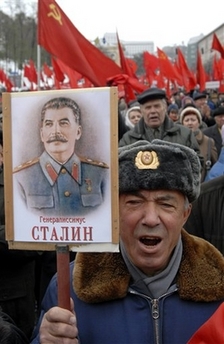
A communist holds a portrait of Soviet leader Josef Stalin as he takes part in the rally dedicated to the 89th anniversary of the Bolshevik revolution in Kiev, Ukraine, Tuesday, Nov. 7, 2006. (AP Photo/Sergei Chuzavkov)
Read More »